 Evansville Tuckpointing
 Tuckpointing and Repointing in Evansville
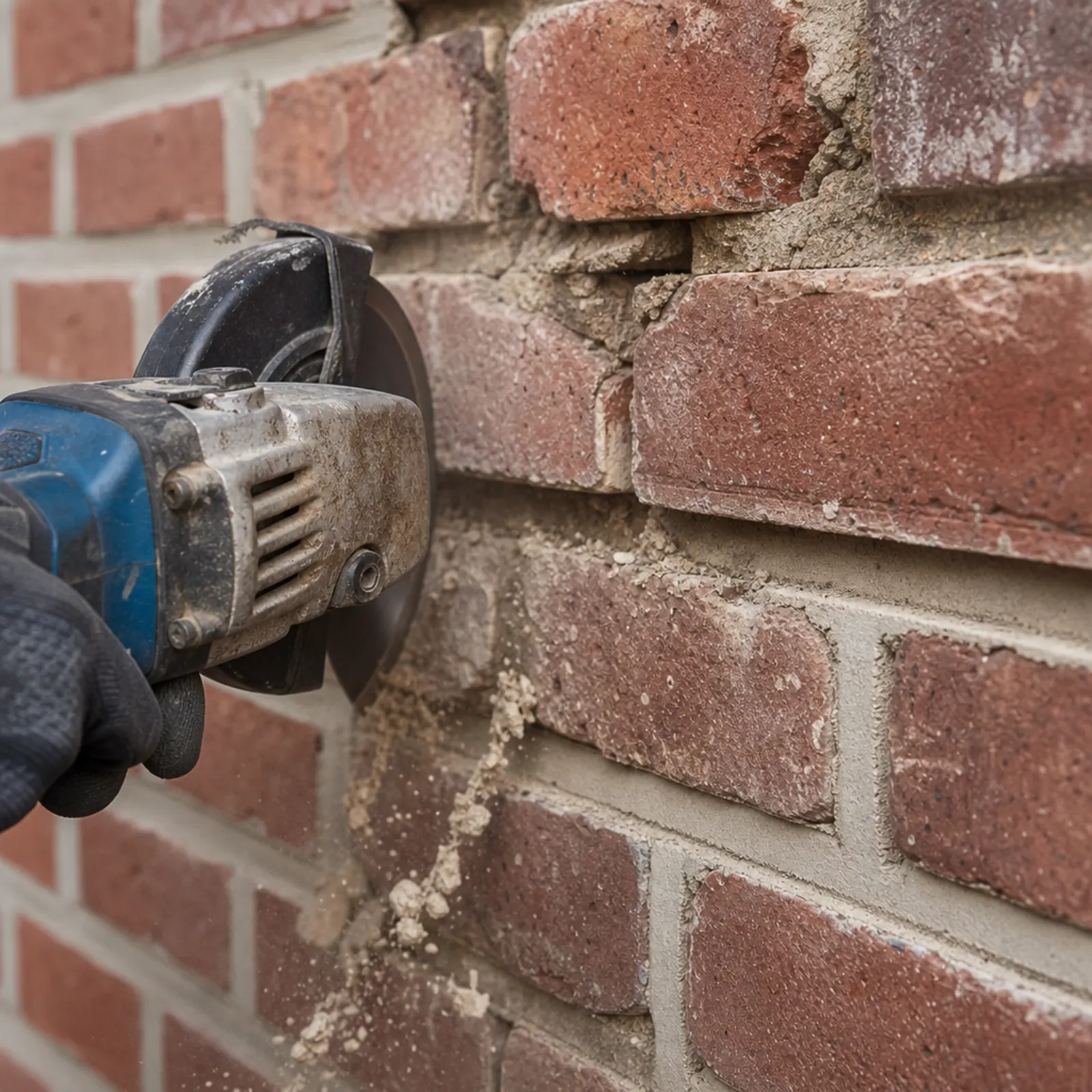
Tuckpointing in Evansville runs $8 to $20 per square foot of wall: the failed mortar ground or raked out to at least 3/4 inch, the joints cleaned and dampened, new mortar packed in lifts and tooled to match the original profile, with the mortar chemistry matched to the age of the brick. A single two-story elevation usually costs $1,500 to $6,000, and our jobs carry a $500 to $800 minimum. Send photos of the joints and the chimney and you get a diagnosis and a real number.
Around here tuckpointing and repointing mean the same thing, and both describe a repair that is easy to do badly. The two things that decide whether the job lasts thirty years or two winters are the depth of the grind and the softness of the mortar. Everything below is about those two things.
Why Evansville joints fail
Roughly 77 freeze-thaw cycles a winter. NOAA’s 1991-2020 normals for Evansville Regional Airport count 92.6 nights a year with a low at or below 32 degrees and only 15.5 days with a high at or below 32. On the difference, about 77 days, the wall freezes overnight and thaws by afternoon. December averages 19.8 freezing nights, January 23.6, February 19.2, and March still 11.9. Water in a mortar joint expands when it freezes, pushes the joint open a fraction, thaws, and draws in a little more water. Repeat 77 times, then run a wet spring over it: 4.60 inches of rain in March, 5.14 in April, 5.12 in May by the same normals. By the third winter the joint is a channel and the brick behind it is saturated.
The mortar is often the wrong mortar already. Brick laid in this city before about 1930 was set in lime mortar. Portland cement, per the National Park Service’s Preservation Brief 2, was not in common use until the early 20th century, and by the 1930s masons were using equal parts Portland and lime. From the 1950s onward most repointing in Evansville was done with hard bagged mortar, Type N at about 750 psi or Type S at about 1,800, on brick that was designed to sit in mortar closer to Type K at 75 psi or Type O at 350. The hard joint stays put and the soft brick face takes the freeze-thaw damage instead. If you see popped brick faces beside intact grey joints on a house in Riverside or Goosetown, that is what happened, and the fix is replacing the units and repointing in a softer mortar. The blog post on lime versus Portland goes deeper.
Where the brick came from
Evansville was founded in 1812 and grew hard in the second half of the 19th century; by 1900 it had roughly 41 furniture factories employing about 2,000 people. The brick housing that money built is the core of the work here:
- Riverside Historic District (National Register 1978, about 425 structures between Southlane Drive, Walnut, Third, and Parrett): 1850s to 1920s, from the Zurstadt House of about 1853 to the Reitz Home of 1871. Lime mortar, soft brick, hand tools only.
- Washington Avenue, Culver, and Bayard Park: Washington Avenue’s Italianate and Queen Anne housing dates to about 1880; Culver developed from around 1890 on the Parrett farm; Bayard Park’s 335 contributing buildings went up after the 1893 deed restrictions that made it Evansville’s first planned development. All lime-era brick.
- Lamasco and the Independence district on the West Side: 95 contributing buildings from after 1880 around West Franklin Street and Wabash Avenue, much of it German-built commercial brick, often painted or sandblasted at some point, which the Indiana DNR’s brick guidance identifies as the two treatments that do the most damage.
- Lincolnshire (platted after 1923, locally designated 1999): Tudor and Colonial Revival brick, harder units, mortar with some Portland in it. Type N is usually right.
- Post-war ranches across the East Side and out to Newburgh: hard brick, Type N or S, concave joints, and failures at lintels and sills more than in the wall.
How a proper repoint goes
- Assess. Sound the wall for hollow spots. Map the cracks: horizontal joint loss is mortar; stair-step cracks over openings are usually a rusted lintel; vertical cracks at corners are movement. Check the chimney crown and flashing. Look in the basement for efflorescence.
- Take a mortar sample. Color, sand size and color, and hardness. The new mortar gets matched to it, and in the historic districts a test panel gets tooled before the wall does.
- Grind or rake to depth. At least 3/4 inch, and per Preservation Brief 2 a minimum of 2 to 2.5 times the joint width, which on most brick is 1/2 to 1 inch. A diamond blade on hard brick, cutting the bed joints and hand-chiseling the head joints so the blade never touches an arris. On soft historic brick, hand chisels and mash hammers, which the Park Service calls the method that poses the least threat to the brick. Square corners at the back of the cut so the new mortar keys in.
- Clean and dampen. Joints rinsed of dust, then left damp with no standing water. Absorbent old brick gets misted for a few hours beforehand so it does not pull the water out of the mortar before it cures.
- Pack in lifts. Mortar goes in roughly 1/4-inch layers, each allowed to reach thumbprint hardness before the next, which minimizes shrinkage. Deep joints take three or four lifts.
- Tool to match. Concave, grapevine, beaded, weathered, flush, or raked, matched to what is on the wall.
- Cure. Mist in hot weather, cover against rain, protect from freezing. Never placed with the wall below 40 degrees and falling or above 90.
What no good mason does is butter new mortar over old. It photographs well and fails in two winters.
What it costs
| Scope | Range |
|---|---|
| Repointing, modern hard brick | $8 to $14 per sq ft |
| Repointing, historic lime mortar | $12 to $20 per sq ft |
| One elevation, two-story home | $1,500 to $6,000 |
| Service minimum (most crews) | $500 to $800 |
Before you compare bids, price your own elevation with the free masonry calculators, and if you are still working out what the wall is doing, the problems index sorts it by symptom. The drivers are mortar type, access and height, joint profile, and how far the water got. Ground-floor Type N work on a ranch in Newburgh is the bottom. A three-story north elevation in Riverside off scaffolding, hand-raked, in matched lime mortar with a beaded joint, is the top. The pricing page has the full portfolio. Batch the work: chimney plus sills plus the parapet in one visit beats three service minimums.
Licensing and review
Indiana has no state license for masons. Evansville and Vanderburgh County license the trade through the Building Commission in Room 310 of the Civic Center: a brick and masonry contractor license takes a $25,000 bond, $300,000 in general liability insurance, an exam, and three hours of continuing education a year. Ask any mason for it, us included, and on Henderson jobs ask for the City of Henderson specialty license that names masonry.
In the Riverside Preservation Area, city code requires a Certificate of Appropriateness before any conspicuous change to the exterior of a historic building, and the District Guidelines list masonry as a reviewed project with three tiers: a staff letter that no certificate is needed, a staff-level certificate, or a commission-level certificate. Matched repointing that does not change material, texture, or color is ordinary maintenance under code 2.106.100, but the staff letter is the paper you want before work starts. Lincolnshire’s local review covers only demolition, moving, and new construction.
Timing
April through November. NWS Paducah’s record for Evansville puts the average last spring freeze at April 6 and the average first fall freeze at October 29. Fall is the smart time to close open joints so this year’s rain does not become January’s ice. Winter work under heated enclosures is possible and priced accordingly.
Crews repoint across Evansville and out to Newburgh, Henderson, Boonville, Mount Vernon, Princeton, and Haubstadt. Send a wide shot of the elevation, a close-up of the worst joints with a coin for scale, and the chimney from the ground, and you will get a straight answer on what needs repointing and what does not.
Frequently Asked Questions
How much does tuckpointing cost in Evansville?
Tuckpointing runs $8 to $20 per square foot of wall. Hard post-war brick off a ladder with Type N mortar is the bottom; soft 1880s brick hand-raked and repointed in lime mortar from scaffolding is the top. One two-story elevation usually lands at $1,500 to $6,000, and most crews carry a $500 to $800 minimum.
How do I know if my joints actually need repointing?
Run a key along a joint. If mortar crumbles out, or the joint is recessed more than about 1/4 inch behind the brick face, or you can see daylight or hairline gaps between mortar and brick, it needs work. Check the chimney, the parapet, and the north wall first because they fail years ahead of the rest of the house.
What mortar will you use on my house?
It depends on the brick. Pre-1930 brick in Riverside, Bayard Park, Haynie's Corner, and Lamasco gets a lime-based mortar matched for color and sand, because hard Portland mortar spalls soft brick. 1930s to 1970s brick usually gets Type N, and newer brick and block gets Type S. The mortar type is written on the quote.
Does repointing need a permit or historic review in Evansville?
Repointing itself is generally ordinary maintenance and needs no building permit, but Evansville licenses masons locally, so any crew, ours included, should hold the Building Commission's brick and masonry contractor license. In the Riverside Preservation Area the Historic Preservation Commission's District Guidelines list masonry as a reviewed project, and matched repointing usually gets a staff letter confirming no certificate is needed. Ask before the grinder starts.
How long does a proper repoint last?
The National Park Service says a good repointing job should last at least 30 years and preferably 50 to 100. That assumes the joints were ground to depth, packed in lifts, tooled to match, and cured properly. A skim coat over old mortar lasts about two Evansville winters.
More masonry services
Areas we serve
- Evansville, IN
- Tuckpointing and Brick Repair in Boonville, Indiana
- Tuckpointing and Brick Repair in Chandler, Indiana
- Tuckpointing and Brick Repair in Fort Branch, Indiana
- Tuckpointing and Brick Repair in Haubstadt, Indiana
- Tuckpointing and Brick Repair in Henderson, Kentucky
- Tuckpointing and Brick Repair in Mount Vernon, Indiana
- Tuckpointing and Brick Repair in Newburgh, Indiana
- Tuckpointing and Brick Repair in Owensboro, Kentucky
- Tuckpointing and Brick Repair in Princeton, Indiana
- Tuckpointing and Brick Repair in Vincennes, Indiana
- Tuckpointing and Masonry Repair in Jasper, Indiana