 Evansville Tuckpointing
 Brick Repair and Replacement in Evansville
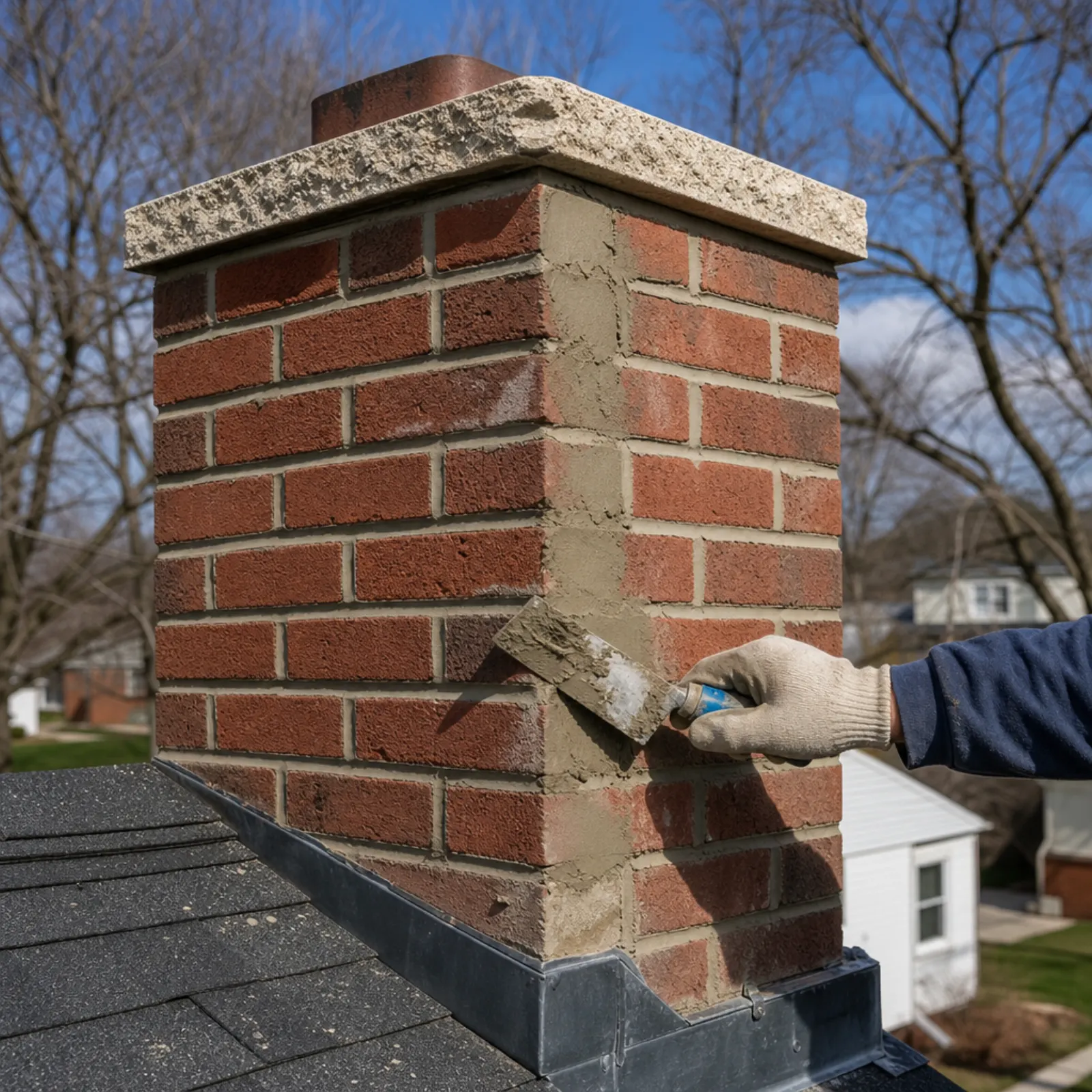
Brick repair in Evansville runs $20 to $40 per brick for cutting out spalled, cracked, or loose units and replacing them with matched brick set in matched mortar, with small spot repairs landing at $300 to $900 and a $500 to $800 minimum on our jobs. The skill is in the match: size, color, texture, and above all the mortar, because on a pre-1930 house the spalling usually started with the wrong mortar. Send photos with a coin for scale and you get a unit count and a number.
What brick failure looks like here
- Spalled faces: the fired outer skin of the brick has popped off, leaving a soft, pinkish, sandy core exposed. The core absorbs water faster than the face did, so it keeps going. Most common on chimneys, parapets, north walls, and below sills.
- Cracked units: a crack through the brick rather than around it. A single cracked brick is a bad brick; a line of cracked bricks running diagonally from a window corner is a lintel or settlement problem and replacing the brick alone will not hold.
- Loose or displaced brick: the mortar has failed entirely and the unit moves. On a chimney above the roofline this is a safety issue.
- Efflorescence and staining: white salts or dark water stains on the face. Not brick failure yet, but the water that will cause it.
- Bulged veneer: a section of brick standing proud of the wall. Rusted wall ties or a failed lintel. Stop and get it looked at.
Why Evansville brick spalls
Two reasons stacked on each other. The first is weather: NOAA’s 1991-2020 normals for Evansville Regional Airport count 92.6 nights a year at or below 32 degrees but only 15.5 days that stay frozen, so the wall freezes and thaws roughly 77 times a winter, with 45.31 inches of annual precipitation to keep it wet. Water inside a brick expands when it freezes, and the fired face is the thinnest, stiffest part of the unit, so the face goes.
The second reason is the mortar. Brick made in Evansville’s 19th-century yards for the houses of Riverside, Bayard Park, Goosetown, and Lamasco is soft, fired unevenly, and sometimes underfired on the inside of the clamp. It was laid in lime mortar that was softer still, which the National Park Service’s Preservation Brief 2 describes as the traditional lime putty and sand mix used until Portland cement came into common use in the early 20th century. When those walls were repointed decades later in hard Type N or S Portland mortar, the joint became stronger than the brick. Freeze-thaw stress has to go somewhere, and it went into the brick faces. The Indiana DNR’s guidance on historic brick names the other two culprits you will find on older Evansville houses: sandblasting, which stripped the protective fired skin, and paint, which trapped moisture behind it.
That is why brick replacement on an old house is never just brick replacement. If the mortar around the spalled units is hard Portland, replacing the brick and leaving the mortar means the new brick spalls next. The honest scope is units plus repointing in a compatible mortar, and the quote says so.
The brick you are matching
- 1850s to 1920s hand-molded and early machine brick: Riverside (National Register 1978, about 425 structures), Washington Avenue (about 1880), Culver (from about 1890), Bayard Park (after 1893), and the Independence district in Lamasco (after 1880). Irregular sizes, soft, red to orange, often with a darker fired face. Salvage is the best source, and there is plenty of it in this city.
- 1920s to 1950s wire-cut and pressed brick: Lincolnshire’s Tudor and Colonial Revival houses (platted after 1923) and the older East Side. Harder, more uniform, in tapestry reds, browns, and buff. Reproduction lines usually get close.
- Post-war modular brick: the ranches of the East Side, Newburgh’s 1960s and 1970s growth, and the newer county subdivisions. Catalog matches exist, and the failures are usually at lintels and sills rather than in the field.
- Limestone trim on all three generations: sills, caps, keystones, and water tables in Indiana’s Salem Limestone. Those are their own trade; see stone and limestone repair.
How a replacement is done
- Count and diagnose. Every spalled or cracked unit is marked, and the pattern is read. A scatter of spalls under a sill is water from the sill. A band across the chimney is the chimney. A diagonal line is a lintel.
- Cut out the unit. Mortar around the brick is cut with a diamond blade or hand tools, the brick is broken out from the center so the neighbors are never levered, and the cavity is cleaned to sound mortar.
- Match the unit. Salvage or reproduction, judged dry in daylight against the weathered wall, sized to the original so the joints stay the same width.
- Set in matched mortar. Lime-based for old brick, Type N for mid-century, Type S for modern. The new unit is buttered, pushed home, and the joints packed and tooled to the profile on the wall.
- Repoint the surround. The joints around the repair, and any hard Portland joints next to spalled brick, get ground out and repointed so the repair is not an island in a failing wall.
- Cure. Misted in heat, protected from freezing, and never placed below 40 degrees and falling.
Pricing
| Scope | Range |
|---|---|
| Brick replacement | $20 to $40 per brick |
| Small spot repair (a few units, one visit) | $300 to $900 |
| Replacement plus surround repointing | $20 to $40 per brick plus $8 to $20 per sq ft |
| Service minimum (most crews) | $500 to $800 |
Modern brick with a catalog match at ground level is the bottom. Hand-molded historic brick sourced from salvage, cut to fit, set in matched lime mortar from scaffolding, is the top. Above a few dozen units on one elevation, the question becomes whether the whole face should be repointed, and the quote should address it. The full table is on the pricing page.
Historic districts and licensing
In the Riverside Preservation Area, city code requires a Certificate of Appropriateness before any conspicuous change to the exterior of a historic building, and the Historic Preservation Commission’s District Guidelines list masonry as a reviewed project. Replacing brick in kind, matched in size, color, and texture, is the definition of what the guidelines want, and it usually gets a staff letter rather than a commission hearing, but ask the Historic Preservation Officer first. Evansville licenses masons locally: the Building Commission’s brick and masonry contractor license requires a $25,000 bond and $300,000 in liability coverage. Ask any mason, us included, to show it.
Timing and service area
Brick can be set April through November; NWS Paducah puts Evansville’s average last freeze at April 6 and first freeze at October 29. Loose brick on a chimney gets handled as soon as the weather allows, with a temporary cover if it cannot.
Crews replace brick across Evansville and out to Newburgh, Henderson, Boonville, Mount Vernon, and the Gibson County towns. Send a wide shot of the elevation, a close-up of the spalled area with a coin for scale, and a photo of whatever is above it (sill, crown, gutter), and you will get a count, a diagnosis, and a number.
Frequently Asked Questions
How much does brick replacement cost in Evansville?
Individual brick replacement runs $20 to $40 per brick, and small spot repairs of a handful of units land at $300 to $900 because the mortar match and the service minimum dominate. Modern brick with a catalog match is the bottom of the range; hand-molded 1870s brick from a salvage yard is the top. Photos with a coin for scale get you a count and a number.
Why are the faces popping off my brick?
Spalling. Water gets into the brick, freezes about 77 times an Evansville winter, and blows the fired face off. On pre-1930 houses the usual cause is a past repointing in hard Portland mortar, which traps water in the soft brick and forces the freeze-thaw damage into the unit instead of the joint. The fix is replacing the spalled units and repointing in a softer mortar.
Can you match old brick?
Usually, from salvage or reproduction. Evansville has a deep supply of salvaged 19th-century brick because so much of the city was built in it, and modern reproduction lines cover most 1920s to 1960s colors and sizes. The match is judged in daylight against the weathered wall, and on a soft historic wall it is often better to turn a salvaged brick to show a weathered face than to install a bright new one.
Should I paint or seal the brick after repair?
No paint, and be careful with sealers. The Indiana DNR's brick guidance says painting brick traps moisture and spalls it, and film-forming sealers do the same. Fix the joints, the crown, the flashing, and the drainage so the wall can dry out. If a breathable treatment is ever warranted, it is a vapor-permeable siloxane, not a surface film.
More masonry services
Areas we serve
- Evansville, IN
- Tuckpointing and Brick Repair in Boonville, Indiana
- Tuckpointing and Brick Repair in Chandler, Indiana
- Tuckpointing and Brick Repair in Fort Branch, Indiana
- Tuckpointing and Brick Repair in Haubstadt, Indiana
- Tuckpointing and Brick Repair in Henderson, Kentucky
- Tuckpointing and Brick Repair in Mount Vernon, Indiana
- Tuckpointing and Brick Repair in Newburgh, Indiana
- Tuckpointing and Brick Repair in Owensboro, Kentucky
- Tuckpointing and Brick Repair in Princeton, Indiana
- Tuckpointing and Brick Repair in Vincennes, Indiana
- Tuckpointing and Masonry Repair in Jasper, Indiana